Public website and provider search
Navigation, service pages, location information, physician directories, filters, maps, and contact paths.
- Keyboard and screen reader use
- Search and filter states
- Content structure and contrast
DigitxlLink maps the digital path patients use to find care, schedule, complete intake, access records, pay bills, and attend telehealth visits—then combines manual WCAG testing, code-level remediation, assistive-technology validation, and review-ready evidence across the systems responsible for that journey.
Current HHS date for covered 15+ employee recipients: May 11, 2027. Technical accessibility services—not legal advice.
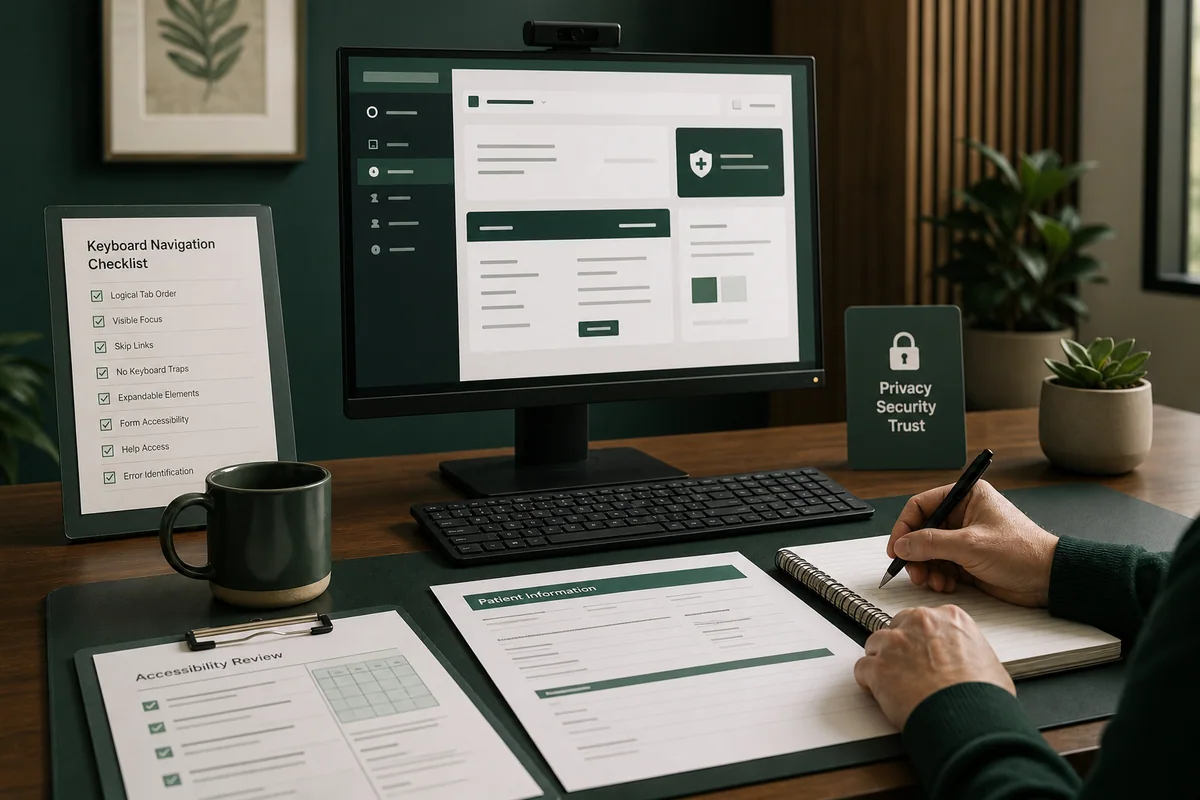
The review follows the patient task across organizational and vendor boundaries. A public website can pass a scan while scheduling, records, payment, or mobile steps still block assistive-technology users.
Navigation, service pages, location information, physician directories, filters, maps, and contact paths.
Appointment selection, registration, insurance details, consent, validation, confirmation, and error recovery.
Sign-in, MFA, messages, test results, records requests, statements, payment, and session-management states.
Native apps, embedded tools, video visits, downloadable forms, instructions, and third-party patient services.
These government materials help healthcare teams understand why a review should follow the patient workflow beyond marketing pages.
The Department of Justice alleged that patient and records-request portals did not work properly with screen readers. The settlement covered websites, portals, web-based services, and mobile apps, along with training, accessibility ownership, testing, and independent evaluation.
Why it matters: The patient journey can extend through scheduling, records, communication, and billing systems operated across multiple platforms.
Read the DOJ case materials (opens in a new tab)These dates apply to covered recipients of HHS funding under the updated Section 504 rule. The rule’s web and mobile provisions use WCAG 2.1 Level AA. Applicability and legal obligations should be confirmed with qualified counsel.
Read the HHS announcement (opens in a new tab)Start with one priority patient workflow and leave with a practical record your compliance, IT, operations, and vendor teams can use.
Apply the full assessment fee to a $4,500 remediation pilot started within 30 days.
Request the readiness assessment Final scope is confirmed in writing before work begins.Each issue stays connected to the user impact, affected workflow, WCAG criterion, owner, fix direction, and retest outcome. The result is an implementation record—not a blanket legal conclusion.
Audit-only work is typically planned for 5–10 business days. Audit plus approved remediation and validation is commonly planned for 2–4 weeks. The written scope controls.
Identify public pages, authenticated steps, vendor transitions, documents, mobile surfaces, and the highest-impact tasks.
Combine automated checks with keyboard, screen reader, zoom, responsive, form, content, and component-state review.
Route findings to the internal team, DigitxlLink, or a third-party vendor with evidence and practical fix guidance.
Record resolved, partial, open, regressed, and vendor-blocked findings against the tested release and scope.
We organize the handoff around the people who need to act: engineering, vendor management, compliance, and operations.
Priorities, reproduction steps, screenshots, affected workflow, owner, and WCAG reference.
Code guidance for internal teams and concise escalation notes for vendor-owned systems.
Pass, partial, open, regressed, and blocked statuses tied to the tested release.
Release checkpoints, ownership, training needs, and follow-up recommendations.
Portal work, native apps, PDFs, captions, telehealth, and third-party tools are included only when they are named in the scope. Page or template limits in standard pricing do not automatically extend to those systems.
Reviewed August 2026. We prioritize government, court, standards-body, and original settlement materials.
DigitxlLink provides technical accessibility services, not legal advice. An audit, remediation engagement, validation record, or ACR does not guarantee legal compliance or protection from claims.
Read the service disclaimerShare the website, portal, form, or mobile flow you want reviewed. We’ll map the surfaces, owners, verified barriers, and next practical step before any codebase access is needed.