What makes a website production ready?
A website is not production ready just because the pages look finished. It is ready when the important paths have been checked, the launch details are in place, and the team can trust what happens after publish.

Production ready means usable after launch
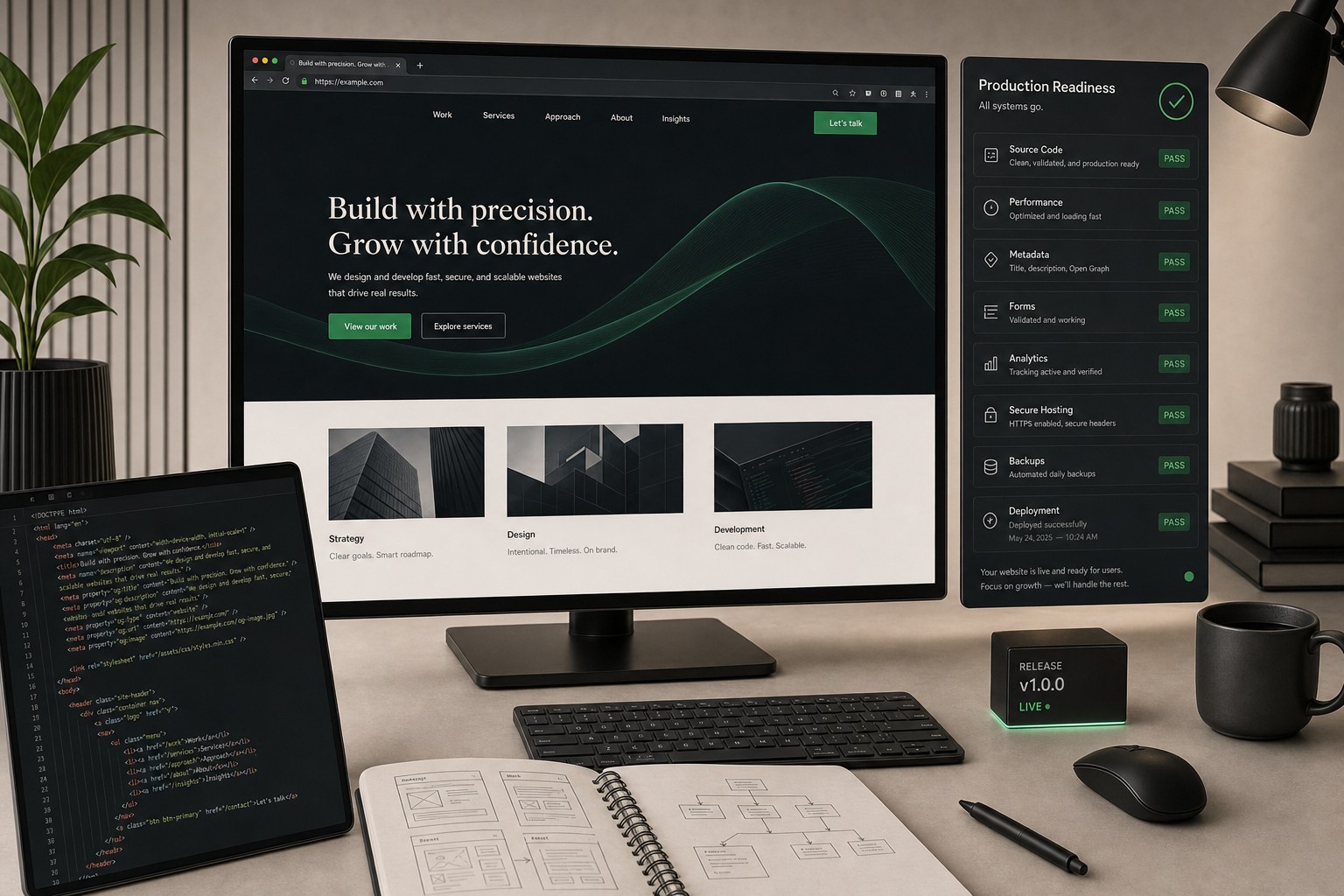
A production-ready website is a working business asset. It should be responsive, understandable, trackable, accessible at a foundational level, and stable enough for customers to use without the team needing to watch every click after publish.
Design approval is only one part of launch readiness. A production-ready website has been reviewed across the paths people actually use: navigation, contact forms, lead flows, page templates, metadata, analytics, redirects, responsive layouts, search visibility, and core accessibility behavior.
The goal is to reduce avoidable launch risk. When pages are published without these checks, teams often discover broken forms, mobile layout issues, missing metadata, confusing navigation, failed redirects, or analytics gaps after traffic has already arrived.
Production readiness starts with scope
A site cannot be production ready if nobody knows what production includes. Before launch, the team should know which pages are in scope, which templates are reusable, which forms are live, which integrations matter, and which items are intentionally deferred.
Scope control keeps the launch practical. It separates the site that needs to go live now from future improvements that can be planned after real user behavior is available.
- Approved page list, template list, and any pages intentionally held for a later phase.
- Primary conversion paths, including contact, booking, quote requests, downloads, purchases, or signups.
- Required integrations such as forms, CRM routing, scheduling, analytics, chat, email marketing, or payment tools.
- Content ownership for copy, images, legal language, service details, pricing, and resource pages.
- Launch assumptions for hosting, domain, DNS, redirects, CMS access, and maintenance responsibility.
Responsive QA protects real visitors
Most visitors will not experience the site on the same screen used during design review. Responsive QA checks whether the site still works when headings wrap, cards stack, images resize, forms compress, menus collapse, and CTA sections move into single-column layouts.
The review should focus on the pages that shape trust and conversion. If a hero section, pricing card, navigation menu, contact form, or service page breaks on mobile, the site is not ready for production.
- Mobile, tablet, laptop, and wide desktop review for approved page templates.
- Navigation and dropdown behavior across touch and pointer devices.
- Text wrapping, button sizing, card alignment, image cropping, and section spacing.
- Form usability on small screens, including labels, inputs, selects, textareas, and submit buttons.
- Review of sticky elements, modals, accordions, tabs, and embedded tools where used.
Forms and conversion paths need proof
A polished website can still fail the business if leads do not arrive. Forms, buttons, links, and destination pages need direct testing before launch. That includes the visible interaction and the behind-the-scenes routing.
Production readiness means the team knows where submissions go, who receives notifications, what success message users see, and what happens if validation fails.
- Required fields, optional fields, validation messages, success states, and error states.
- Notification routing to the correct email, CRM, automation, or database.
- Spam controls, consent language, privacy links, and any compliance-sensitive form copy.
- CTA links to contact, pricing, booking, resources, downloads, or external tools.
- Confirmation pages, thank-you pages, analytics events, and follow-up instructions.
Metadata, redirects, and tracking should be ready
Search and analytics details are easy to overlook because they are not always visible on the page. They still matter. Titles, descriptions, social previews, indexing settings, redirects, and analytics events affect whether people can find the site and whether the business can understand performance after launch.
- Unique page titles and meta descriptions for important pages.
- Open Graph and social preview settings for shared links where relevant.
- Canonical URLs, sitemap expectations, robots settings, and indexing basics.
- Redirects for replaced URLs, old service pages, campaign links, or moved content.
- Analytics, conversion events, pixels, consent-sensitive scripts, and tag placement.
Accessibility foundations belong in the launch review
Production readiness should include accessibility foundations even when a formal audit is a separate service. The launch review should catch common blockers before the public site goes live.
This does not replace a full WCAG audit, but it does reduce avoidable friction. Labels, keyboard behavior, focus visibility, heading structure, contrast, alt text, and clear state messaging all affect whether visitors can use the site confidently.
- Logical heading structure and descriptive page landmarks where applicable.
- Form labels, helper text, validation errors, and clear submit states.
- Keyboard paths for menus, buttons, links, tabs, accordions, and modal interactions.
- Visible focus states, readable contrast, meaningful link text, and image alt text workflows.
- Reduced-motion and animation safety considerations for motion-sensitive visitors.
Performance and stability affect trust
Visitors often judge credibility through speed and stability. If the site feels heavy, shifts while loading, or delays important content, the launch experience suffers. Production checks should review the practical performance items that affect real pages.
- Image sizing, compression, lazy loading, and format choices.
- Script placement for analytics, widgets, embeds, and third-party tools.
- Layout shift risk around images, fonts, embeds, cards, and dynamic content.
- Critical page load experience for home, service, pricing, contact, and campaign pages.
- Hosting, caching, SSL, domain, and CDN basics when they are part of the project.
What you should receive
A production-ready handoff should make the launch understandable. The client should know what was built, what was checked, what systems are connected, and what should happen next.
- Published pages and templates that are live, responsive, and reviewed against the approved scope.
- Launch notes for known decisions, settings, redirects, forms, metadata, and tracking details.
- An access summary for hosting, CMS, analytics, forms, DNS, and third-party systems.
- Known limitations and future-phase recommendations separated from launch-blocking issues.
- Next-step recommendations for accessibility, content, SEO, performance, monitoring, or maintenance.
Post-launch review keeps the site improving
Launch is the start of real feedback. After the site is live, the team should review analytics, form submissions, support questions, page performance, search visibility, and any user-reported issues. That review helps the business move from assumptions to evidence.
A good production-ready handoff makes that review easier because the launch record explains what was shipped and what was intentionally left for later.
Conclusion
Production readiness is the standard that turns a finished-looking site into a site the business can trust. Use it before launch so quality is visible before the site goes live.
The stronger the launch record, the easier it is to maintain the website, diagnose issues, plan improvements, and protect the customer experience after publication.