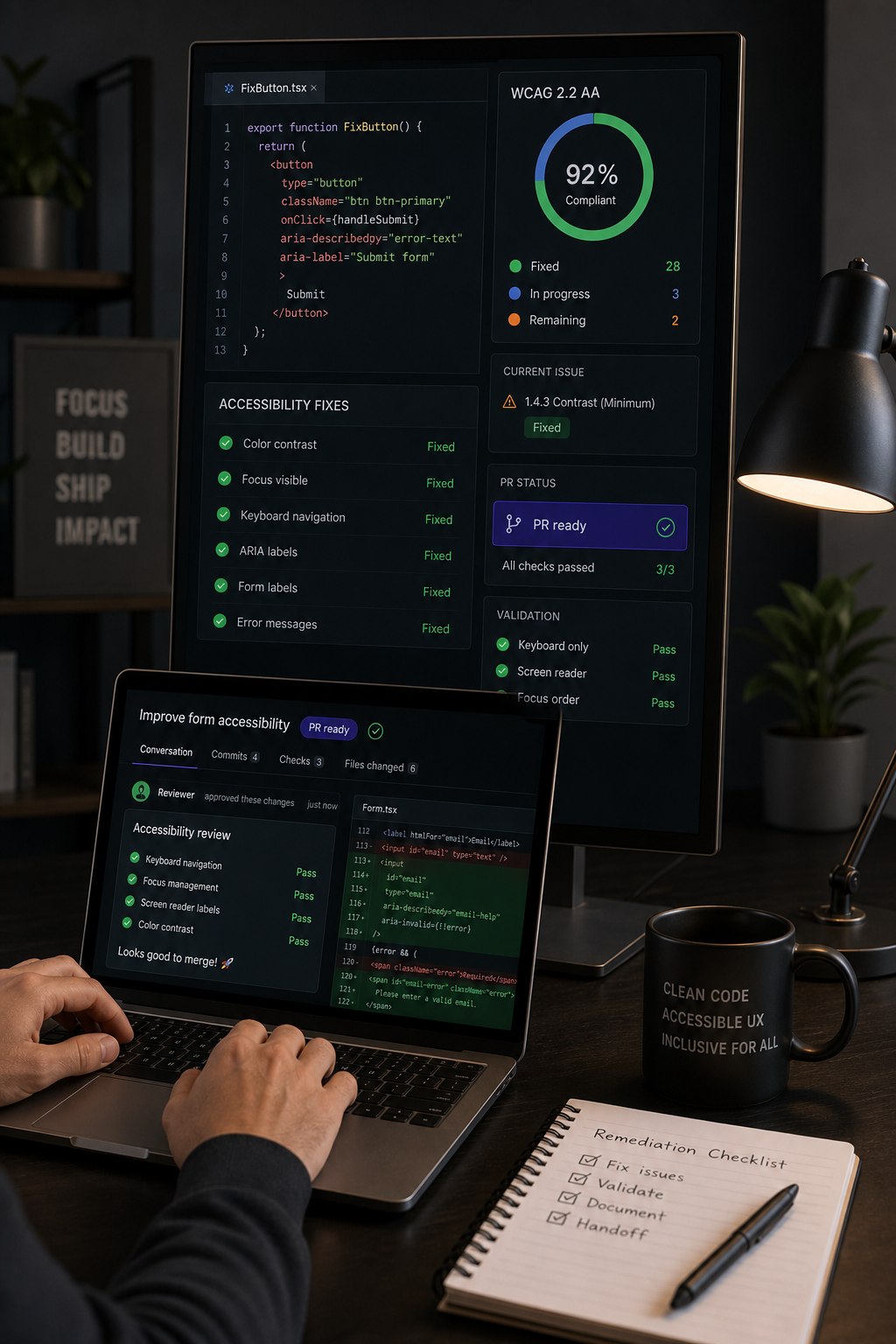
Prioritize fixes by user impact and legal exposure
A framework for backlog sequencing, engineering acceptance criteria, and retesting.


Accessibility remediation stalls when every issue feels equally urgent or when priority is based only on engineering effort. A useful model weighs user impact, legal exposure, affected journeys, component reuse, technical dependency, and retest confidence.
What this helps with
- Best for: engineering managers, product owners, compliance teams, and teams with audit findings ready for intake.
- Outcome: a sequenced remediation backlog that ties each fix to impact, owner, acceptance criteria, and validation.
- Use when: you need to move from a report to a release plan without losing risk context.
Use a four-part priority model
Start with the practical question: which barriers stop disabled users from completing important tasks, and which fixes reduce the most risk fastest? Severity should be informed by WCAG criteria, but the product context determines urgency.
- User impact: does the issue block, delay, confuse, or degrade a critical user journey?
- Exposure: is the issue visible in high-traffic, revenue, public-sector, healthcare, finance, or procurement-sensitive workflows?
- Reuse: is the barrier in a shared component that appears across many screens?
- Effort: can the fix ship quickly, or does it depend on design, architecture, vendor, or release constraints?
Keep severity grounded in user reality
Severity labels are useful only when they describe real consequences. A missing accessible name on a primary checkout button is not the same as a decorative icon with a redundant label. A focus trap in a modal can be more disruptive than a low-contrast secondary badge.
Group findings by the user outcome they affect: can the person find it, understand it, operate it, complete it, recover from an error, and confirm the result?
Prioritization principle: fix blockers and reusable patterns early. One well-scoped component fix can remove dozens of repeated violations and reduce future regression risk.
Sequence the backlog in delivery waves
A remediation backlog should not be a flat list. Sequence work into waves so product, design, engineering, QA, and compliance know what is being reduced first.
- Wave 1: blockers in critical flows, keyboard traps, inaccessible forms, missing names on essential controls, and broken navigation.
- Wave 2: shared component repairs, design-system updates, repeated content patterns, and template-level fixes.
- Wave 3: lower-impact enhancements, content cleanup, edge states, and documentation improvements.
- Ongoing: regression coverage, release checks, procurement evidence, and validation notes.
Write acceptance criteria engineers can ship
Each fix should include expected behavior, affected assistive technology context, viewport or breakpoint notes, and the WCAG success criteria involved. Acceptance criteria should be specific enough for developers to implement and for QA to retest without guessing.
- Reproduction included: the ticket includes URL, screen, state, device or breakpoint, steps, and observed failure.
- Expected behavior clear: the ticket explains what a keyboard or screen reader user should be able to do.
- Owner assigned: product, design, engineering, vendor, or content ownership is clear before sprint planning.
- Retest method defined: QA knows which keyboard, browser, screen reader, and zoom or responsive state should be checked.
- Evidence retained: the original finding and validation result remain available for compliance and procurement review.
Close the loop with retesting
Remediation is not complete when code merges. It is complete when the original barrier is no longer reproducible in the affected workflow. Retesting should preserve notes on what changed, what passed, what still fails, and whether related components need regression coverage.